Whale Watching in Madeira: Boats, Prices and Rules
VMT from Funchal or Lobosonda from Calheta: prices, trip length, child ages, what you get if no whales show and the 50 m rule.
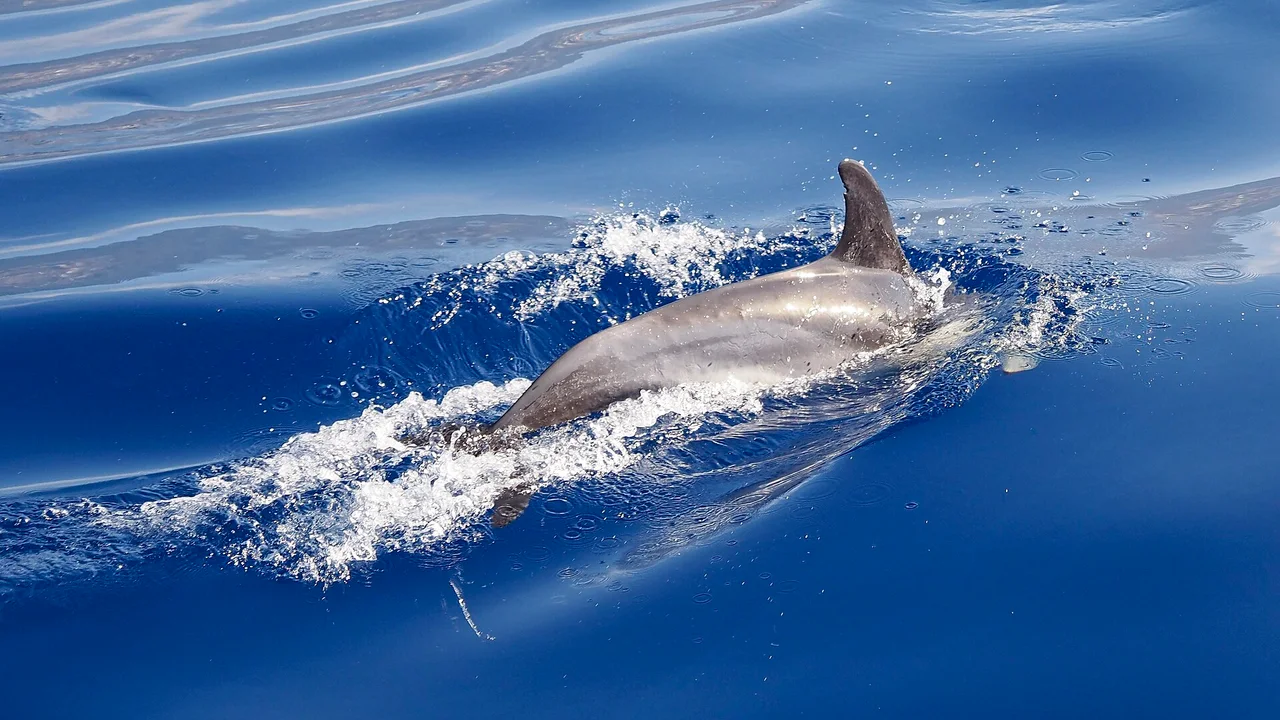
A whale-watching trip in Madeira costs €40 for an adult on VMT’s 3-hour catamaran from Funchal, and €51.83 or €66.63 on Lobosonda’s boats from Calheta marina. The no-sighting offer is narrower than it sounds: VMT gives you a second trip free if nobody sees a cetacean, and a pod of dolphins counts. Lobosonda’s tour pages say there’s no refund when nothing shows; only its older FAQ mentions a “mermaid pass” discount on a later tour. So pick the boat and the harbour you’d enjoy on a quiet day at sea, and count a whale as a bonus.
Three boats, two harbours
Operator prices and terms read on 17 November 2026; they can change, so confirm them when you book.
| VMT catamaran | Lobosonda, Ribeira Brava (traditional boat) | Lobosonda, Steno (speedboat) | |
|---|---|---|---|
| Leaves from | Funchal, Praça do Povo, Cais 8 | Calheta marina | Calheta marina |
| Length | 3 h | 2.5 h | 2 h |
| Adult | €40 (12 and over) | €51.83 | €66.63 |
| Child | €20 (up to 12); free up to 4 | €30.67 (2 to 15) | €40.19 (5 to 15) |
| Minimum age | None; under 4s free | All ages | 5 |
| No cetaceans seen | Second trip free | No refund; older FAQ: “mermaid pass” discount | No refund; older FAQ: “mermaid pass” discount |
| Sea too rough | Rebook or refund | Rebook or full refund | Rebook or full refund |
| Check-in | 30 min before | Closes 30 min before | Closes 30 min before |
For two adults that’s €80 at VMT, €103.66 on Ribeira Brava and €133.26 on Steno. Families with two to four children aged 5 to 12 do better at VMT than the sticker prices suggest: its family pack is €100 for two adults and those children, against €120 for two adults and two children at single prices. On Lobosonda the same four people pay €165.00 on Ribeira Brava and €213.64 on Steno, so the gap is real money. What the extra buys is a different boat: Lobosonda describes Ribeira Brava as a traditional wooden fishing boat and Steno as a RIB whose Ullman hydraulic seats are designed to absorb wave impact. Steno isn’t suitable for children under 5, pregnant women, guests with back problems or previous injuries, or guests with limited mobility.
VMT sails every day, from 10:30 to 13:30 and/or from 15:00 to 18:00, which means the harbour takes about three and a half hours of your day once check-in is counted. Lobosonda’s FAQ says its departure times depend on bookings, so confirm the time when you reserve.
Funchal or Calheta?
Funchal is where VMT sails from, and a morning trip fits around a city day: the Funchal guide covers what to do ashore. Get the exact meeting point from the operator, not just a pin on the waterfront.
Calheta is on the south-west coast, 33 km from Funchal, and Lobosonda says to allow about 45 minutes to drive there, more if parking near the marina is tight. Visit Madeira also lists departures from Machico and Porto Santo. The seven-day drive spends its second night in Calheta, so a morning sailing fits before the short drive on to Porto Moniz. Without a car, Rodoeste runs buses from Funchal to Calheta, and the transport guide explains how SIGA’s three operators fit together. Eat after you’re back on land; the food guide sorts out what to order.
If you see nothing: a free trip or a discount
VMT’s wording is “if no cetaceans are seen”, and cetaceans include dolphins. So the free second trip covers a sea with no dolphins and no whales, not a morning when the dolphins came and the whale you wanted didn’t. VMT’s terms add that the second trip goes to the original clients only and the ticket isn’t transferable, and that there’s no refund for a no-sighting trip.
Lobosonda’s tour pages say refunds for no-sighting trips aren’t available and don’t mention a pass. Its FAQ, which still carries older prices, describes a “mermaid pass” with a discount on a future tour after a trip with no cetaceans, without saying how big. Ask whether the pass still exists before you count on it; it only pays off if you can get back to Calheta on another day.
Bad weather is a separate case. VMT can cancel for bad weather or safety reasons and refunds in the way you paid if you can’t rebook; Lobosonda offers a new date or a full refund, and does the same when a trip falls short of its minimum of 8 participants. If you cancel yourself, Lobosonda refunds in full up to 48 hours before the tour and charges the total within 48 hours, unless it can resell your place. VMT lets you change the date and time free of charge at least 24 hours ahead, subject to availability.
How close a boat may go
Every commercial whale-watching boat in Madeira needs an authorisation from IFCN, the regional nature agency, so it’s fair to ask an operator for it before you book.
Madeira’s own code (Decreto Legislativo Regional 15/2013/M) bans a boat from actively approaching marine mammals closer than 50 m. Each boat may stay with the animals for up to 10 minutes, and all the boats together get 40 minutes, counted from when the first one arrives. So on a busy morning, the boat that turns up last gets only what’s left of that window.
The 50 m rule limits the boat, not the animals: dolphins that come to the bow aren’t a breach. Judge an operator by how it explains these rules, not by how close its promotional pictures look, and follow the crew’s instructions about where to stand.
Lobosonda collects photo-identification and GPS data on each trip, noting species, behaviour and the presence of calves, and passes it to public and scientific institutions. Sightings also depend on people on shore: the IWC handbook explains that Madeira’s high cliffs let operators station spotters, called “vigias”, at vantage points to guide boats to the animals. If you spot someone with binoculars on a headland, that’s probably who they are.
What to expect to see, by season
Visit Madeira calls whale watching a year-round activity, and the IWC handbook agrees: resident bottlenose dolphins and short-finned pilot whales can be seen all year, and sperm whales and striped dolphins show up regularly through the year. Visit Madeira’s list of frequently seen species adds common dolphins, spotted dolphins and Bryde’s whales.
Season changes the mix. According to the IWC handbook, common dolphins are mostly seen in winter and spring, while Atlantic spotted dolphins and Bryde’s whales are seen from spring to autumn. Fin whales appear mainly in winter and spring and sei whales in summer. Cuvier’s and Blainville’s beaked whales are regulars too, but they’re shy and hard to spot. The same source puts the best season for whale watching between spring and autumn.
In practice, a trip in January is mostly a dolphin and pilot whale trip with a chance of a fin whale, and one in July leans towards spotted dolphins, pilot whales and a possible Bryde’s or sei whale. Read that as a tendency from the handbook, not a timetable.
One practical step
Book the first free morning of your stay and keep a later day open: on VMT’s terms that later day is the free second trip. If you’re staying in Funchal, VMT is the cheaper way to do it for a couple or a family, and the Madeira in 5 days plan lets you move the sailing to whichever morning the sea is calm.
Photos
Read also

Things to do · 6 min read
Madeira Levada Walks: 25 Fontes or Caldeirão Verde?
Updated · 17 November 2026Madeira levada walks compared: 25 Fontes or Caldeirão Verde, real distances, tunnels, where each walk starts, the €4.50 slot and cancellation rules.

What to see · 6 min read
Cabo Girão Skywalk: Ticket, Hours and Getting There
Updated · 17 November 2026Cabo Girão skywalk: €5 entry paid through SIMplifica, opening 08:00-20:00, 580 m of cliff, how to get there from Funchal and the Rancho cable car below.

Car hire · 9 min read
Car Hire in Madeira: Licence, Card Hold and Mountain Roads
Updated · 17 November 2026Car hire on Madeira: licence rules, National's €600 or €1,000 card hold, insurance gaps, free expressways and summit closures.

Regions · 7 min read
Pico do Arieiro and Pico Ruivo: PR1 Status, Fees and Access
Updated · 17 November 2026Madeira's two highest peaks: the PR1 ridge trail and fees, the road and bus to Arieiro, the short way up Pico Ruivo when PR1 is shut, and what to check.